

by Jatin Bansal | Nov 22nd, 2026
The CBSE Class 10 Question Paper Pattern is not exactly the same for every subject. Mathematics focuses on problem-solving, Science tests concepts and their applications, and Social Science requires both factual knowledge and understanding. Language papers also assess reading and writing skills.
Depending on the subject, papers may contain multiple-choice, short-answer, long-answer, and competency-based questions. To see the actual structure, students should check the official CBSE sample paper for their subject.
For major subjects such as Mathematics, Science, and Social Science, the usual assessment structure is 80 marks for the board examination and 20 marks for internal assessment. The CBSE Class 10 Marking Scheme 2027 explains how marks are awarded for individual answers.
Do not assume that writing more always means scoring more. A clear answer that addresses the question is usually more useful than a lengthy response filled with unrelated details. Check the official marking scheme to understand what examiners expect.
Some students are comfortable memorising definitions but find application-based questions difficult. Competency-based questions ask you to use what you have learned in a situation, passage, diagram, or problem.
For example, a Science question might describe an everyday observation and ask you to explain it using a concept from your textbook. Practising such questions helps you move beyond memorised answers.
Solving CBSE Class 10 Previous Year Question Papers is a practical way to improve speed and understand how questions have been asked in earlier years. Try one paper under timed conditions, then review your mistakes instead of immediately moving to another.
You can explore previous year question papers and related learning resources on OldYearPaper. Remember that past papers are for practice; the latest syllabus and official CBSE materials should guide your preparation.
Start with your NCERT textbooks and make short notes for topics you often forget. Give extra time to difficult chapters while keeping a little revision time for stronger subjects.
Practise writing answers, not just reading solutions. Use official CBSE sample papers to understand the current format, and revise incorrect answers after each practice session. Short, regular study sessions are often easier to maintain than last-minute cramming.
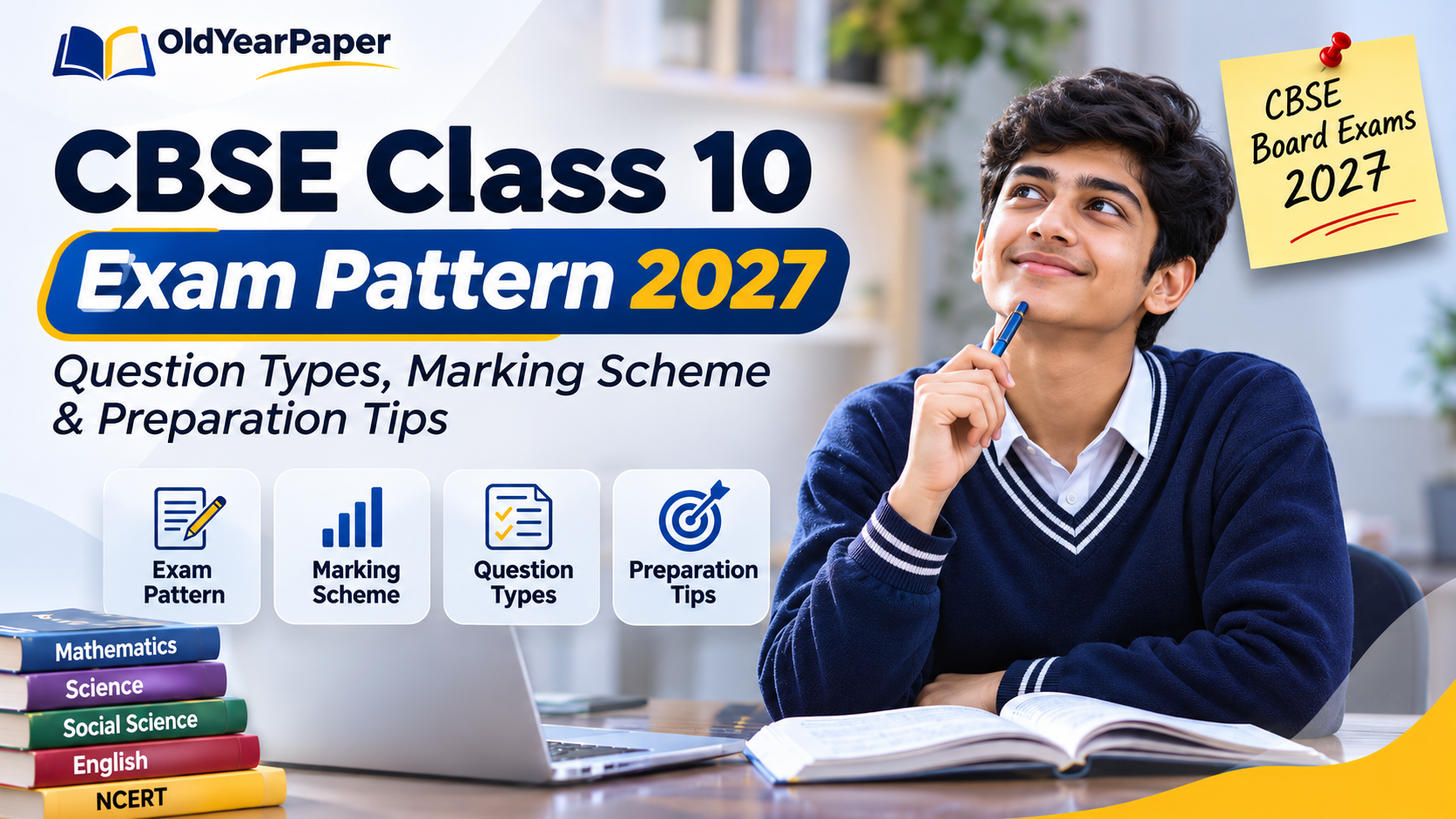
Understanding the CBSE Class 10 Exam Pattern 2027 helps you prepare with a clearer plan. Combine NCERT learning, previous year papers, official marking schemes, and steady revision. Focus on understanding the question before answering it, and use every practice paper to find one thing you can improve.
 CBSE Class 10 Exam Pattern 2027: Question Types, Marking Scheme & Preparation Tips BA vs BBA: Which Course Is Better After 12th? How to Prepare for BPSC TRE Using Previous Year Question Papers: Complete Preparation Guide JEE Advanced 2027 Exam Date Released: Check Exam Schedule and Latest Updates Questions Every Class 9–12 Student Has About Education CBSE Practical Exam Date Sheet 2027 Released: Class 10 & 12 Winter-Bound Schools Schedule Best AI Tools for Students in 2027: 5 Free Study Tools Government Jobs After 12th in 2026: Top Jobs, Salary & Eligibility Importance of Previous Year Question Papers: 10 Benefits RRB JE City Intimation Slip 2026 Link: Check Exam City & Download Slip CLAT 2027 Preparation: 7-Week Strategy & Previous Year Papers 2025 Government Job Alerts: Latest Recruitment Notifications Updated Daily How to Analyze Previous Year Question Papers to Maximize Your Government Exam Success List of Non-Core Branches of Engineering WHAT ARE THE IMPORTANT JOB TITLES IN A COMPANY Core Branches of Engineering in India 2025 TOP COURSES AFTER CLASS 12TH IN INDIA ARTS, SCIENCE AND COMMERCE - OLD YEAR PAPER Selecting an Engineering Branch or College for 12th Passed Students TYPES OF COMPANIES THAT VISIT YOUR CAMPUS PLACEMENTS
Old Year Paper is a one-stop-destination for all your exam preparation needs. We understand the importance of practice and how previous year question papers can be a valuable resource for students. That's why we have carefully curated and compiled previous year question papers for various exams in one place.